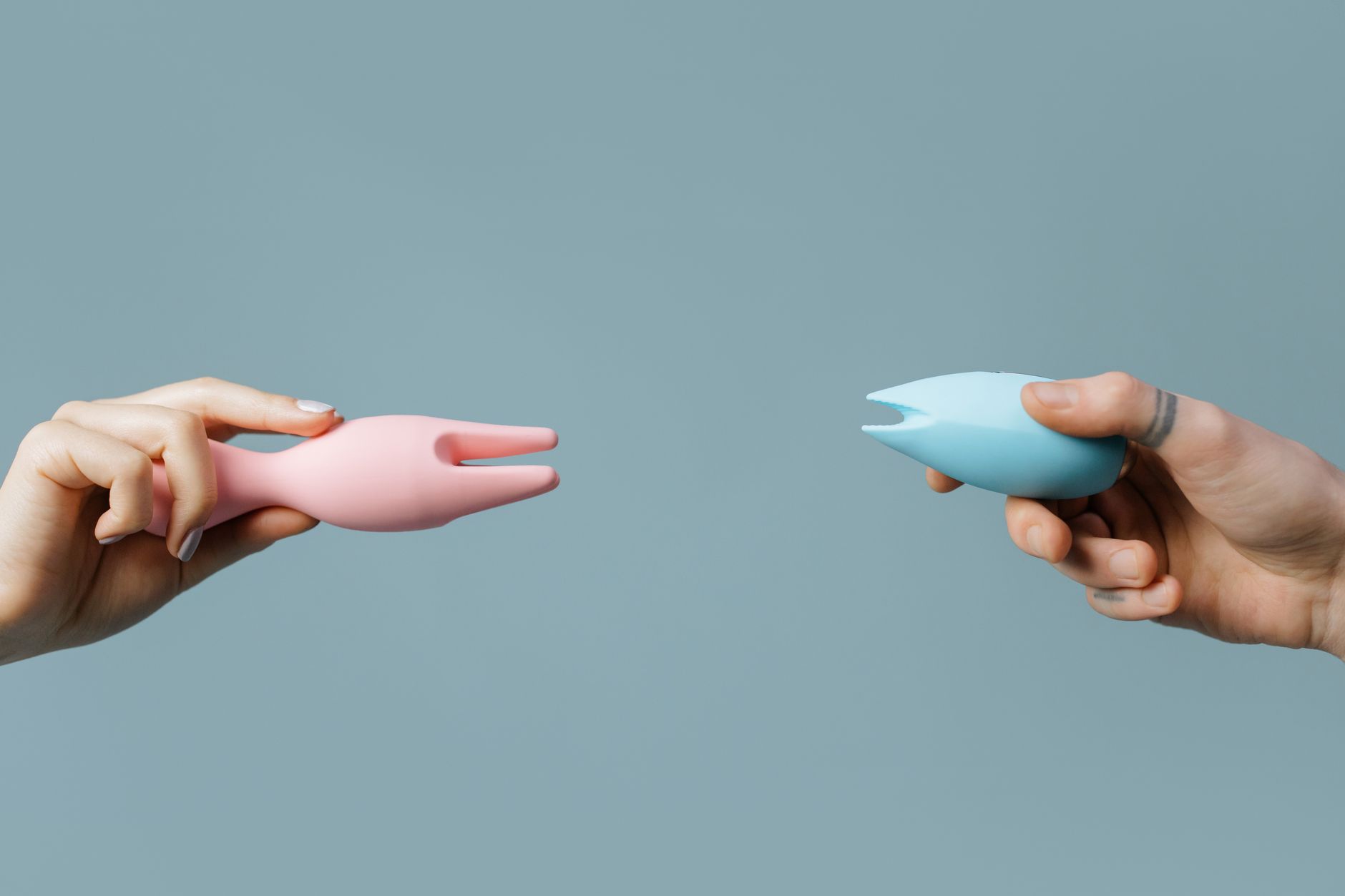
Here's the thing about new relationships and pleasure tools
Introducing a lemon vibrator or any clitoral vibrator early in a new relationship triggers fear in ways most people don't talk about. The fear isn't really about the vibrator. It's about what your partner might think it means about them.
Does it mean you're not satisfied? Does it mean they're not enough? Will they think you prefer it to them? These questions hover in the background, unspoken, and they're the reason many people hide their vibrators from new partners altogether. That silence is usually where the real damage happens.
Why new partners often feel threatened (and how to prevent it)
When someone is still building trust with you, vulnerability feels like a risk. Sex is already vulnerable. Adding a sex toy into that equation can feel like you're saying "I need more than you." It's not logical, but it's deeply human, and it's especially true in the first three to six months when you're still learning each other's bodies.
The paradox is this: the longer you wait to mention a vibrator, the worse the conversation tends to go. If your partner finds out you've been using one secretly, it reads as secrecy. If you introduce it casually early, it reads as openness.
Timing matters. Not because there's a "correct" moment, but because the sooner this conversation happens in a relationship, the more context there is for it to be about pleasure instead of about what's missing.
Photo by DRT.fm on Pexels
When to bring it up (and how to frame it)
I usually recommend the conversation happen after you've been intimate together at least a few times, but before you're in a rhythm where they think they have you figured out. That sweet spot is usually weeks two through five.
The framing matters enormously. You're not saying "I need this because sex with you isn't working." You're saying "I love pleasure and I've learned what works for my body. I'd like to include that here, with you."
The best way to start is informally, not during sex. A text works. A conversation while you're making coffee works. "Hey, so I wanted to tell you something about how I like to have pleasure. I use a vibrator sometimes. I'd love for you to be part of that, but I also wanted you to know because I don't keep secrets about my body." Simple. Matter-of-fact. Not an ask yet, just information.
Wait for their response. Some partners will feel relief (they have permission to introduce their own preferences). Some will need reassurance. That reassurance is important, but it shouldn't be your job to convince them your pleasure is valid. You can say something like, "It has nothing to do with you or what we have. It's just something that feels good for me. I'm mentioning it because you matter and I don't want secrets between us."
How clitoral vibrators actually work (the science that reassures partners)
One of the best ways to dissolve partner anxiety is to explain what a lemon vibrator actually does physiologically. It's not magic or better than a human hand. It's faster, more consistent, and it doesn't get tired. That's it.
A clitoral vibrator like the Lem uses air-suction stimulation that wakes up nerve endings and creates a chain reaction in your nervous system. Your partner's hand cannot do that because hands don't vibrate. His tongue cannot do that. A penis cannot do that. These are different tools that create different sensations. You're not comparing them; you're expanding the menu.
That distinction matters for your partner's sense of self. You're not saying "I need this instead." You're saying "I like this plus." The tool augments. It doesn't replace.
Making the first experience together actually work
Assuming your partner is open to it, the first time you use a vibrator together should feel collaborative, not like a performance. Here's how I'd approach it.
Start alone with your partner watching, if they're willing. Not in a voyeuristic way, but in a "I want to show you how this feels for me" way. Use it for two or three minutes, narrate what you're experiencing ("The vibration right here feels intense," "This pattern is building something"), and then stop and transition into whatever comes naturally. Sex, foreplay, cuddling, conversation. Don't make the vibrator the main event.
The second time, invite them to participate. That might mean they hold it while you direct them. It might mean you use it while they're inside you or touching you elsewhere. It might mean they use it on you while you're touching them. There's no right way. The point is collaboration, not performance.
Many new partners are relieved to learn that a lemon clitoral vibrator actually requires communication. You have to say where it feels good. You have to ask for rhythm changes. You have to be present. That's the opposite of what some partners fear (that you'll use a toy and ignore them). Instead, it deepens attention.
What to do if your partner resists
Some partners will say no. "I don't want that in our sex life" or "It makes me uncomfortable." That's their boundary, and it's worth taking seriously. But it's also worth understanding what's underneath it.
Resistance usually comes from one of three places: insecurity ("Does this mean I'm not enough?"), discomfort with the tool itself ("I think vibrators are weird" or "I have outdated beliefs about how sex should work"), or a control issue (discomfort with you having independent pleasure).
The first two are often workable with conversation and maybe some time. The third one isn't, and that's useful information about the relationship early on.
If your partner is insecure, you can offer reassurance and suggest they explore their own preferences. You might say, "If there's something you've always wanted to try, I'm open to it. I'm not asking for you to do anything you don't want to do. I'm just asking that you let me have my pleasure too."
If they're uncomfortable with the tool or have outdated ideas about sex, you can answer their questions and share information. You might ask why they think a vibrator is weird. Often it's just unfamiliarity. You might suggest visiting a shop together or reading something educational. Information usually softens resistance.
If it's a control issue, that's a relationship pattern worth addressing now, before you're further invested. A partner who can't tolerate your independent pleasure is showing you something important about how they navigate boundaries.
Why the Lem works particularly well early on
If you're going to use a lemon clitoral vibrator with a new partner, the Lem has specific advantages. It's small, which makes it less intimidating for someone who's never seen a high-end vibrator. It's quiet, which means it's not a performance noise that makes people anxious. It's elegant, which reads as "I take my pleasure seriously" rather than "I bought this at a novelty shop."
The suction sensation is also different enough that partners don't feel like they're competing with it. It's not a sensation they could replicate anyway, so there's less anxiety about being "replaced."
The conversation after
After you've used a vibrator together, check in. Not a big emotional processing session, just "How did that feel for you?" or "What did you think?" Most partners will either feel relieved (their anxiety was worse than reality), curious ("Can I try that?"), or neutral ("That was fine"). All of those are fine.
If they want to talk about it more, that's great. Listen. You might hear "That was hot," or "I felt left out," or "That's not for me, but I'm glad you got something out of it." All of that information is useful for shaping how you move forward together.
The biggest gift you can give a new partner is permission to have preferences too. If you're comfortable enough to say "I use a vibrator," your partner gets permission to say "I like it when you touch me this way" or "I've always wanted to try..." That vulnerability is contagious. You're creating a relationship where pleasure is discussed, not hidden.
FAQs
Will introducing a vibrator early make my new partner think I'm too sexual or high-maintenance?
No. It makes you look like someone who knows herself and communicates clearly. Those are attractive qualities. A partner who interprets that as "too much" is showing you they're not comfortable with women having independent pleasure, which is a meaningful incompatibility to know about early.
How do I know if my partner will be receptive before I bring it up?
You don't, which is why the conversation is important. But some signals help: partners who are curious about your body, who ask what feels good, who volunteer their own preferences, and who use words like "us" and "together" are usually more open. Partners who are dismissive about pleasure, who avoid conversations about sex, or who become defensive if you ask for something different are usually less open. Trust those signals.
What if my partner wants to use the vibrator on themselves?
That's perfect. Encourage it. You might discover that your partner loves using a lemon clitoral vibrator during partnered sex, which gives everyone more pleasure. You're not competing; you're both expanding. Some of my clients' favorite experiences are ones where both partners are using vibrators together.
Should I buy a vibrator specifically for the relationship, or use one I already have?
If you already have one, use that. It's real. It's your thing. If you want to buy one together as a couple, that can be a bonding experience. Some couples enjoy browsing together and picking something out. It frames the vibrator as something you're exploring as a team rather than something you're introducing unilaterally.
How do I handle it if my partner says it makes him feel inadequate?
Take it seriously without absorbing it as truth. You might say: "I understand that feels like a threat to you. That wasn't my intention. A vibrator doesn't replace you. It's a different sensation. I want you in my pleasure, and I also want to know what pleasure is available to my body. Those things aren't contradictory." Then offer him space to work through it. Some partners need time. Some need to experience it. Some stay uncomfortable, and that's a choice they're making about the relationship.
Is there an age at which introducing a vibrator is inappropriate with a new partner?
No. The conversation and the tool work at any age. People over 40, 50, and 60 are discovering vibrators and introducing them to partners. New partners benefit from clarity about preferences at every life stage.
You deserve partnership that includes pleasure
Introducing a lemon vibrator to a new partner is ultimately about claiming ownership of your body and your pleasure. It's about saying, "I know what feels good to me, and I'm not going to hide it or wait for permission." That clarity is attractive. It builds trust. And the partners worth keeping are the ones who see your pleasure as part of the relationship, not a threat to it.
If you want to explore more about how to navigate intimacy conversations early in relationships, our guide to rekindling desire with a partner after time apart covers similar ground. And if your partner is interested in learning your body more deeply, that's a conversation worth having early too.
Your pleasure is valid. Your preferences deserve space. And the right partner will make that easy.